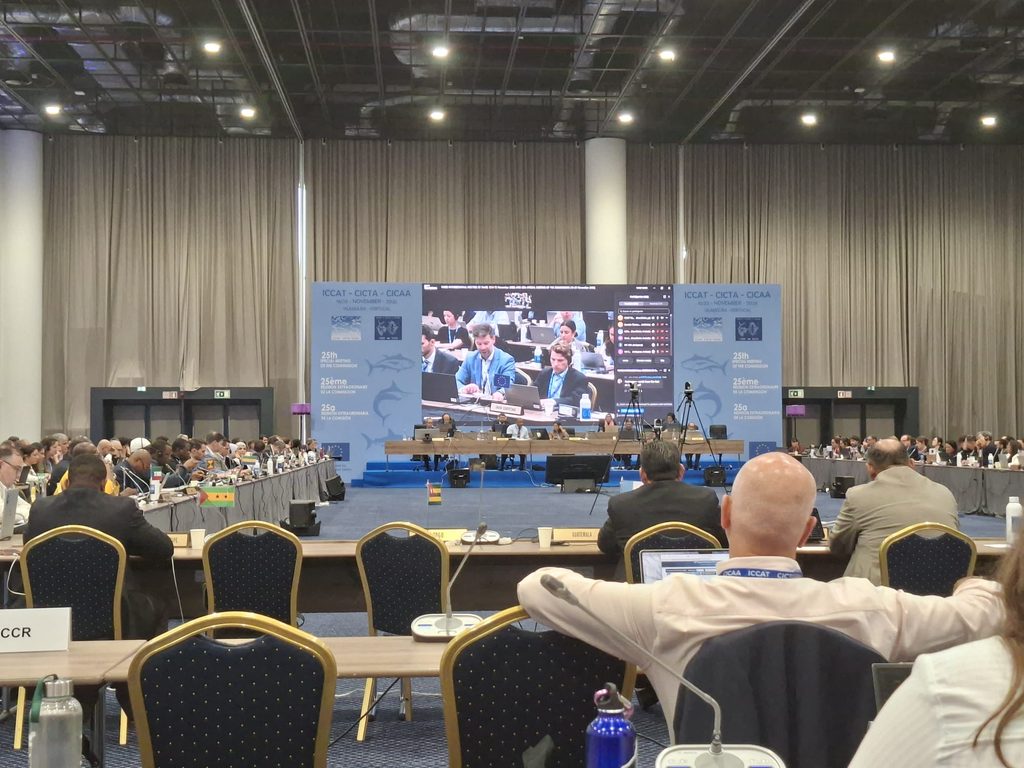
The annual meeting of the International Commission for the Conservation of Atlantic Tunas (ICCAT) took place in Vilamoura, Portugal, from 16 to 23 November 2026.
Once again, no agreement on yellowfin tuna allocation
For yet another year, ICCAT parties failed to reach an agreement on the allocation of yellowfin tuna fishing opportunities. The Total Allowable Catch (TAC) has been consistently exceeded for the past 12 years, and ICCAT’s Scientific Committee (SCRS) has repeatedly called for an allocation scheme to put an end to this systematic overshooting.
With a new yellowfin tuna stock assessment scheduled for next year, there is a real risk that the TAC will have to be reduced, making future allocation negotiations even more difficult. Meanwhile, the long-term sustainability of the stock is being put at risk, along with the future of the fishers who depend on it. The FAD closure also remains in place, despite the lack of scientifically demonstrated benefits for tropical tuna stocks and its severe socio-economic consequences for the European fleet.
Xavier Leduc, President of Europêche Tuna Group, deplores: “What makes this outcome particularly disappointing is that, from our perspective as observers, several Contracting Parties, including the EU, showed willingness to find a solution. Yet no common negotiating text was circulated until the eve of the meeting’s conclusion, and no dedicated working group was formally established to bridge the differences expressed during the session.”
He adds: “Was this a failure of leadership, or simply a collective difficulty to move forward? Whatever the reason, another year has been lost. We sincerely hope that next year’s meeting will finally deliver the compromise that is so urgently needed.”
Progress on other tropical tuna measures
On a more positive note, ICCAT parties agreed to move forward with the much-needed Management Strategy Evaluation (MSE) for western skipjack and implemented the planned adjustment to the bigeye tuna TAC. They also aligned the BioFAD calendar more closely with that of the Inter-American Tropical Tuna Commission (IATTC), to better reflect operational realities.
Shark management: missed opportunity for shortfin mako, progress on fins naturally attached
On North Atlantic shortfin mako, Europêche regrets that ICCAT failed to translate the latest scientific advice into concrete management action. Despite the 2026 stock assessment confirming that overfishing is no longer occurring, ICCAT has maintained the retention ban, forcing fishermen to discard already-dead sharks instead of allowing their controlled landing, to be ultimately consumed and avoid both biological and economic waste.
Anne-France Mattlet, Director of Europêche Tuna Group, deplores: “We had called for a science-based approach permitting the retention of dead bycatches under strict monitoring conditions, without jeopardizing stock recovery, hoping as well that other CPCs would improve discards reporting. Instead, keeping the status quo putting the pressure in the European fleet, EU being the only CPC reporting discards, fails to address the real issue and opens the door to potential further restrictions on blue shark fisheries.”
Regarding the adoption of Japan’s proposal on sharks’ fins attached, Europêche celebrates moving towards a level playing field on this matter, as the EU fleets have been compliant for 13 years. Mattlet adds: “We remain cautious that the exemptions permitted for other fleets to adjust don’t become the norms.”
Ends
Press contact:
Anne-France Mattlet, Europêche Tuna Group Director: +33 6 78 11 63 01 anne-france.mattlet@europeche.org