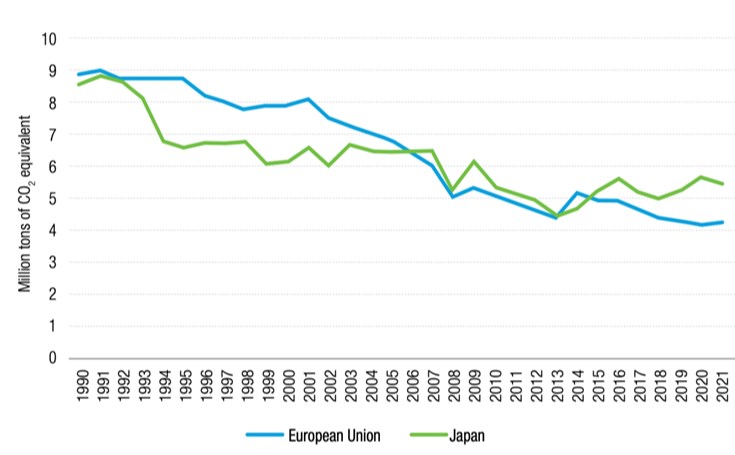
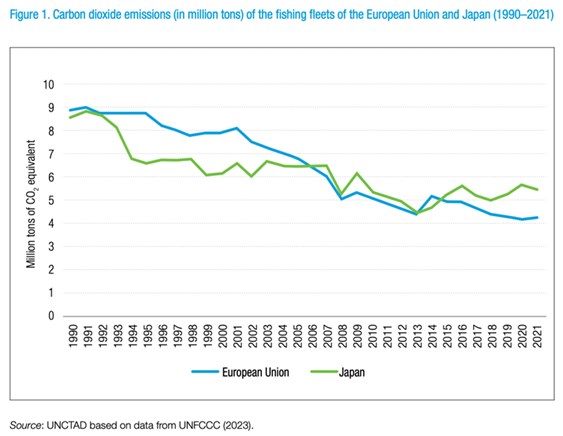
A recent study produced by the United Nations Conference on Trade and Development (UNCTAD) [1], provides a first global mapping of the main challenges and opportunities of the energy transition of fishing vessels, particularly for developing countries. To do that, the study explores the interface between climate change, CO2 emissions and fishing fleets by analysing emissions data and ocean and fisheries commitments under the Paris Agreement. The study highlights that the total GHG emissions of the EU fishing fleet fell by 52 % between 1990 and 2021, from 8.9 to 4.3 million tons of CO2 equivalent. Europêche, the leading representative body of the European fishing industry, welcomes the positive trend and stresses the fishing sector’s positive role in fighting climate change while producing low carbon seafood.
The fisheries sector is important for food security, jobs and for the livelihoods of millions of people, especially in developing countries. The fishing industry is also an important source of jobs and livelihoods, with more than 40 million people working in fisheries and aquaculture in 2020. By way of comparison, there are 20 times more fishers than seafarers worldwide. On the other hand, energy efficiency and GHG emission reduction are vital for addressing both climate change and pollution.
According to the study, fishing vessels contribute between 0.1 and 0.5 % of global CO2 emissions and represent approximately 4 % of the carbon emissions generated by global food production. The study also reminds that fish production generates less carbon emissions per calorie than raising cattle or pork, and it is the only animal protein considered to have a low carbon footprint.
Daniel Voces, managing director of Europêche, commented: “The fishing industry’s environmental footprint is almost negligible if compared with other sources of GHG emission. This becomes even more evident considering that, based on figures declared by the European Commission, fisheries emissions from the EU constitute merely 3% of the reported 0.1-0.5% of global fisheries emissions. Yet, as an industry, we remain steadfast in our commitment to consistently reduce our footprint and actively contribute to minimizing our environmental impact”.
The UNCTAD study also highlights that EU fisheries emissions decreased as a result of a 28% reduction in the fleet size of the EU between 2000 and 2020, and investments in energy efficiency, including diesel electric engines, efficient refrigeration and propeller systems. These elements have permitted to cut EU’s fleet emissions by 52%.
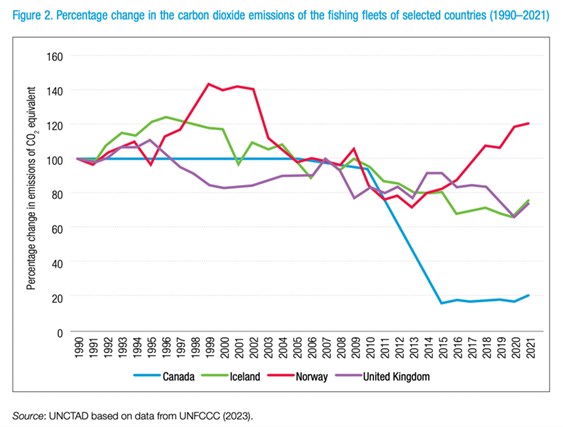
Daniel Voces, stated: “It is impressive to witness the substantial progress achieved by European fishers, bringing the EU fleet remarkably close to the ambitious target outlined in the EU Green Deal: a 55% reduction in greenhouse gas emissions by 2030, compared to 1990 levels [2]. The fishing sector is therefore reaching environmental goals nearly six years ahead of the stipulated deadline, an achievement worthy of admiration. This accomplishment becomes even more noteworthy when contrasting it with neighbouring countries such as Norway, Iceland, or the UK, which are currently not aligning with this positive trend. Notably, despite Norway’s fleet size reduction, they report higher emissions than those recorded in the 1990s”, (see figure 2 below).
According to Europêche, this positive evolution in the EU, unmatched by any other sector, must go on and trigger further changes. In this vein, to achieve climate-neutrality by 2050, the EU must set the course towards a holistic strategy incorporating zero-emission energy sources, upgrading vessels and enhancing gear design. This will no doubt require more space on board for vessels to install new technologies along with increased financial support. In this context, Europêche urges the Commission to swiftly eliminate regulatory barriers, particularly fishing capacity constraints, and to allocate sufficient financial resources. This decisive action is essential to empower companies to meet the challenge of energy transition effectively. EU authorities cannot afford losing more valuable time.
[2] 1990 is the baseline year used for emissions of carbon dioxide under the Kyoto Protocol, an international agreement to limit emissions of greenhouse gases emissions.
Press contacts:
Rosalie Tukker, Senior Policy Advisor of Europêche: +32 2 230 48 48 rosalie.tukker@europeche.org