Europêche reaction to CJEU Preliminary ruling on TACs above ‘ICES zero-catch advice’
12 de January de 2024
7

We express our satisfaction with the recent court decision, as it aligns with the longstanding position advocated by the EU fishing sector. The Court of Justice of the European Union (CJEU) has acknowledged a crucial perspective: fisheries management should not only prioritize environmental concerns but also consider the well-being of companies, the economy, and the people involved.
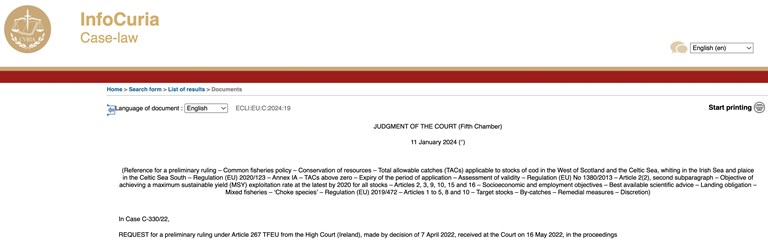
Rigidity in the strict application of scientific recommendations, particularly in this case where a total ban on catches (0 TAC) was suggested for species incidentally caught in mixed fisheries, would have had devastating consequences. It could have led to the early closure of the fishery for our vessels, even though our fishers still have significant quotas for other species. This effect known as ‘choke species’ is caused by the ill-conceived EU landing obligation. This EU policy exacerbates the under-utilisation of fishing possibilities and increases the risk of premature closure of fisheries since for some key stocks fishers may have little or no quotas. It must therefore be revised as soon as possible.

It is nonetheless encouraging to see the court’s recognition of the complexity of managing mixed fisheries, where bycatch of non-target species is unavoidable. It confirms that fishing all stocks in a mixed fishery at maximum sustainable yield at the same time is practically impossible. That is why stocks that are predominantly caught as by-catch, must be managed according to the precautionary approach and not the MSY policy.

Ultimately, we are pleased with the court’s decision acknowledging the Council’s ability to exercise its discretion to determine fishing quotas. This approach prevents a scenario whereby biological considerations automatically transform into law, neglecting other crucial scientific aspects of the decision-making process such as practical implementation or the socio-economic data produced by the Scientific, Technical and Economic Committee for Fisheries (STECF), national administrations or EU Advisory Councils. The latter allows to better balance environmental, social and economic sustainability in fishing decisions.

In conclusion, scientific recommendations must inform political decisions with evidence-based options and scenarios, and not the opposite. Otherwise, the door would be open to a judicialization process in the establishment of fishing opportunities. Policy decisions should be left to those with a broader understanding of societal needs, political considerations and trade-offs. That’s the essence of a democratic process.

EP Press Release – Europêche reaction CJEU TAC Fishing OPPS

EUSeA regrets exclusion of aquatic foods from EU protein agenda

Fisheries and Aquaculture Vision 2040 must deliver an EU Blue Foods Action Plan Brussels, 23 July...

WaveForward sets course for modernising fisheries training across Europe

The WaveForward project - Modernising Fisheries Training for Today’s Challenges - has been...

Joint press release: European social partners call for an EU directive to implement the STCW-F convention

The European Transport Workers’ Federation (ETF), Europêche, and Copa-Cogeca have issued a joint...

BOUTCAR unveils an innovative training pathway for blue skills and careers

The BOUTCAR project[1] successfully concluded its three-year journey with two final events held in...

Europeche welcomes momentum for a more competitive and simplified fisheries policy

Europêche welcomed the constructive exchange with European Commissioner for Fisheries and Oceans...

Europêche strengthens its team to enhance communication and project activities across EU fisheries policies

Europêche, the leading representative body of the EU’s fishing sector, is reinforcing its team to...

European Commission recognises Port Victoria as meeting EU landing control standards

On 2 June, two years after the publication of the European Control Regulation Implementing act on...

Europêche and Member States discuss next steps for a more balanced and competitive EU fisheries policy

Yesterday, Europêche met with EU Member States representatives under the Cypriot Council...

Tuna liberalisation via free trade agreements and ATQs: How much duty-free competition can the European fleet absorb?

After publishing a draft Comprehensive Economic Partnership Agreement (CEPA) with Indonesia, and...

SUBSCRIBE TO OUR NEWSLETTER

At Europeche, we have plenty to share with you — don’t miss out on any news, updates, events, or projects we’re working on.

DATA CONTROLLER: Europeche. PURPOSE: Management of web contacts. LEGAL BASIS: The legitimate interest of users and, where applicable, the preparation and execution of a commercial relationship. Consent. RECIPIENTS: No data transfers to third parties are foreseen. Data Processors may handle your information. RIGHTS: You may access, rectify, and delete your data, as well as exercise other rights. ADDITIONAL INFORMATION: You can consult additional and detailed information on data protection in the Privacy Policy at https://europeche.org.