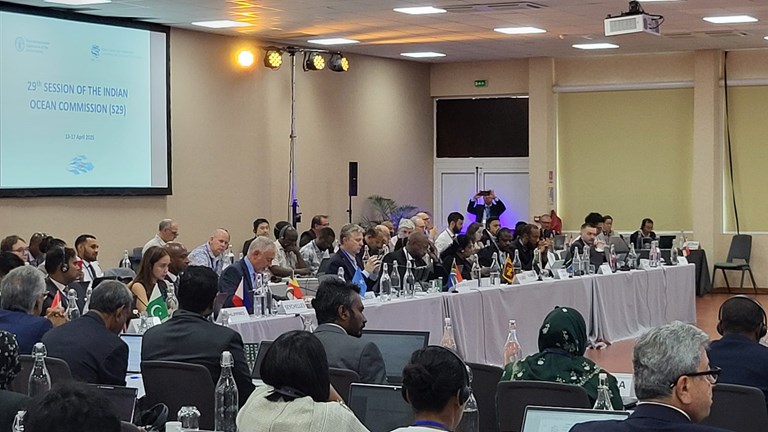
The 29th session of the Indian Ocean Tuna Commission (IOTC), held in La Réunion from 13 to 17 April 2025, concluded with the adoption of a full management framework for tropical tunas. This is a key step which will allow now to focus on other tuna species and control measures, in order to ensure a minimum level playing field between the different fleet within the Indian Ocean. Europêche calls on all IOTC parties and stakeholders to implement and enforce the adopted measures as soon as possible, as well as to begin addressing management needs for other tuna and associated species.
Significant progress on tropical tuna management
The adoption of catch limits for skipjack and bigeye, following the previous establishment of management procedures for these stocks, marks a notable advancement towards an efficient, science-based management framework for tropical tunas. With all three major tropical tuna species now under catch limit regimes, the IOTC has laid the groundwork for long-term sustainability.
To complete this framework, IOTC must now take advantage of the good status of yellowfin tuna stock to develop an inclusive management plan and avoid unilateral actions that could compromise sustainable exploitation of tropical tunas in the Indian Ocean.
“This is a milestone for the region,” stated Anne-France Mattlet, Director of the Europêche Tuna Group. “We now have the tools to ensure the long-term sustainability of skipjack, bigeye, and yellowfin——now we need consistent, inclusive implementation across all fleets to make it happen.”
A measure on sharks was also finally adopted, which strengthens fighting against shark finning and improve shark management.
Voting procedure, a threat to the RFMO’s future
While the IOTC remains an essential forum for multilateral cooperation, the adoption of the skipjack measure through a voting procedure—rather than consensus—reflects a broader shift that could challenge the effectiveness of future IOTC measures. Although voting is foreseen in the IOTC rules, the increased use of this mechanism risks a rise in formal objections, weakening the cohesion and enforceability of conservation measures.
Control loopholes and uneven obligations
Of particular concern is the decision to exempt Indonesia from the requirement to deploy IOTC-certified independent observers on at-sea transhipments (IOTC Regional Observer Programme). Given the crucial role of observers in verifying compliance and collecting reliable data, such exemptions may create significant loopholes in monitoring and increase the risk of IUU fishing.
More generally, once again, discussions on high-seas boarding and inspection, shark finning bans, and improved monitoring of gillnet fisheries failed to advance, largely due to persistent opposition from a small group of countries. Despite the EU proposal, crew labour standards were regrettably also absent from the discussions.
Finally, despite clear and repeated signals from the Scientific Committee regarding the poor status of several minor tuna and billfish stocks, IOTC failed to reach agreement on even the most basic measures to address their depletion.
“The growing divide between fleets bound by strict oversight and those operating with minimal controls is extremely worrying,” warned Xavier Leduc, President of the Europêche Tuna Group. “We are witnessing the emergence of a two-speed IOTC: one where certain fleets are held to the highest standards of transparency and sustainability, and another where loopholes and leniency prevail. Sustainable management depends on uniform rules, applied consistently and backed by robust control mechanisms. Without this, we risk eroding the very principles on which the organisation was built.”
Press contacts:
Anne-France Mattlet, Europêche Tuna Group Director: +33 6 78 11 63 01 anne-france.mattlet@europeche.org
Daniel Voces, Managing Director of Europêche: +32 489 26 81 07 daniel.voces@europeche.org