The European Scientific, Technical and Economic Committee for Fisheries (STECF) annual report[1] on the performance of the Common Fisheries Policy (CFP) brings excellent news for another year on the good progress on the state of EU fish stocks. The scientific report shows a substantial drop in fishing pressure over the period 2003-2018 in the North-East Atlantic. On average, for all the stocks evaluated in this area, fishing pressure has been reduced almost by half in the last 20 years, reaching maximum sustainable yield levels (MSY) for most of them. As a consequence, fish populations have been increasing significantly, reaching in 2018 levels 50% higher than in 2010. However, further efforts are still needed, particularly in the Mediterranean.
The STECF is the European Commission’s scientific body which provides independent scientific advice for the conservation and management of living marine resources, including biological, economic, environmental, social and technical considerations. This allows policy-makers to build their decisions based on solid science evidence, better understand the health of a stock, determine how much can be fished, and closely monitor the implementation of the CFP.
The STECF report evidences overall positive trends for many fish stocks in the ecoregions across Europe. This is clearly confirmed by the fact that in the North-East Atlantic the proportion of overexploited stocks was reduced almost by half if compared with 2007 figures (p. 26). The proportion of stocks outside safe biological limits shows a similar downward trend under the same period (p. 28). The good news in these waters do not end here, as recruitment figures show that the number of young fish entering the stocks is consistently increasing since 2012, which may explain the increase in stock’s production. However, Europêche notes that the latter figure should be treated with caution since it may not reflect the reality of certain fish species largely impacted by environmental factors.
Managing Director, Daniel Voces, declared: “The news on sustainable fisheries is unequivocally good. The majority of fish stocks in the North-East Atlantic are healthy and thriving. That’s thanks to many years of sacrifices being made by the EU fishing fleets and intensive collaboration with scientists and public authorities to improve fishing practices and fisheries management. Overfishing in the EU is at an all-time low”.
Europêche regrets that radical environmental NGOs keep on launching gloom and doom studies trying to proof how horrible things are in European waters by analysing the number of fish stocks or tonnes overfished in the past. Mr Voces reacted: “It really upsets the industry that some NGOs do not recognise the good progress made in the past 20 years. It frustrates the efforts of our companies that invest in sustainable practices and want to do things better. It generates an ambience of mistrusts, jeopardising the collaboration of the industry with scientists, governments and NGOs”. He continued: “It also confuses consumers that, because of aggressive campaigns from these organisations, may think that the oceans and fish stocks are in a dire situation and that consuming fish would contribute to harm the environment, when it is totally the opposite. The reality is that in the last 10-20 years no industry has made so many efforts and commitment towards sustainability like the European fishing industry”.
Europêche argues that part of the problem lies with the fact that the main EU fisheries law introduces targets and objectives which go against scientific advice and the fisheries reality. In this sense, even though scientists acknowledge that it is not possible to achieve MSY levels for all stocks at the same time, this is an actual objective of the CFP.
Mr Voces concluded: “Incredible accomplishments to achieve sustainability in our waters have been made in a record time, to the point that almost 100% of the landings from EU-regulated stocks come from catches fished at the MSY levels. However, the introduction of unachievable policy objectives in the CFP, reform after reform, unfairly gives the impression to citizens and consumers that the fishing industry is not sustainable. Policies need to be ambitious but rational at the same time”.
In the Mediterranean, many populations remain overfished due to inadequate fishing pressure levels which peaked in 2011. Europêche is nevertheless convinced that the new plan for the Mediterranean will deliver an important contribution towards better conservation and sustainable exploitation of fish stocks.
1 Monitoring the performance of the Common Fisheries Policy (STECF-Adhoc-20-01)
* The STECF graphs below illustrate the significant reduction of fishing pressure (F/FMSY), increase of biomass (B/B2003) and recruitment (R/R2003) in the North East Atlantic (NEA).
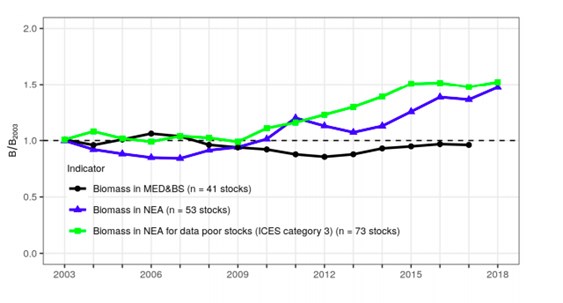
Figure 1: Trends in the indicators of stock biomass (median values of the model-based estimates relative to 2003). Three indicators are presented: one for the NE Atlantic (53 stocks considered, blue line); one for the Mediterranean & Black Seas (41 stocks, black line); and one for data limited stocks (ICES category 3, 73 stocks, green line) (p.8).
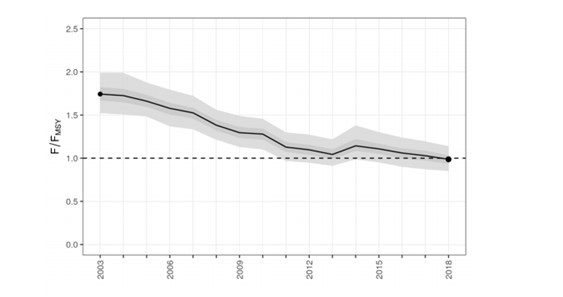
Figure 2: Trend in F/FMSY (based on 46 stocks). The figure shows the indicator values since 2016 close to 1, which means that over all stocks, on average, the exploitation levels are close to FMSY. Dark grey zone shows the 50% confidence interval; the light grey zone shows the 95% confidence interval (p. 32).
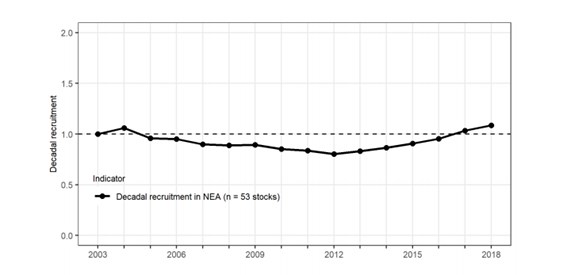
Figure 3: Trend in decadal recruitment scaled to 2003 in the Northeast Atlantic area (based on 53 stocks) (p.8).
Press contact:
Rosalie Tukker, Policy Advisor of Europêche: +32 (0)2 230 48 48